Place orders
There is no brokerage connection, no order endpoint and no order tool. A test asserts none exists.
Feed Orbit the news, filings and notes you trust. It separates what the sources actually say into verified bullish and bearish evidence, tells you how strong that evidence really is, and shows you where it stops.
Not investment advice. Orbit cannot place trades, has no live market data and cannot predict prices. Sources can be wrong or out of date.
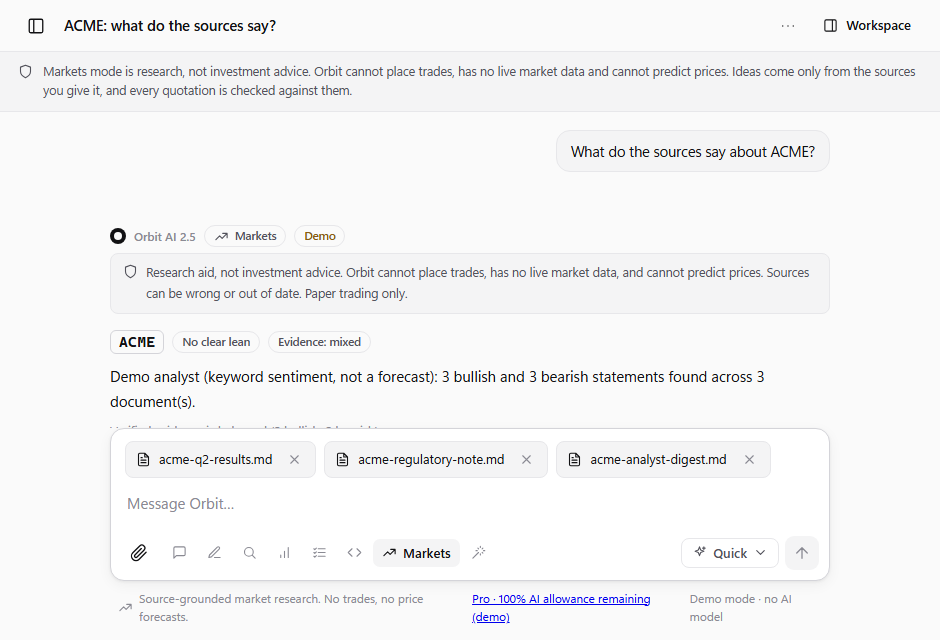
Attach articles, filings and notes. Orbit only reasons from what you give it.
Each claim needs an exact quotation, checked word-for-word. Unverified claims are not shown as evidence.
Orbit, not the model, rates the evidence from insufficient to strong, and downgrades a stance the evidence does not support.
Record simulated trades, backtest a simple rule on prices you supply, and size risk. No real money moves.
The same rules as the app, copied exactly and kept identical by an automated test. They run in your browser, and nothing you type is sent anywhere.
These interactive examples calculate locally in your browser. Use fictional numbers; nothing is sent or saved. They are arithmetic demonstrations, not investment recommendations.
A backtest can look better than it is. These are the choices Orbit makes to keep it honest.
There is no brokerage connection, no order endpoint and no order tool. A test asserts none exists.
It works from documents and prices you provide. Nothing is fetched, and prices you import are as old as you made them.
No forecasts and no probabilities. Evidence strength describes your sources, not the future.
Orbit is not a licensed financial adviser and does not give personal investment advice.
Explore the local preview through its screenshots and examples. Public accounts, uploads and live AI are not available yet.